A Dispatch
Entry No. 008
No One Knew
What “AI psychosis” looked like from the inside — a trial lawyer, a manic episode, and the machine that never noticed I was disappearing.
There were photographs. There were transcripts. There was a diagnosis. None of them, alone, could tell the whole story.
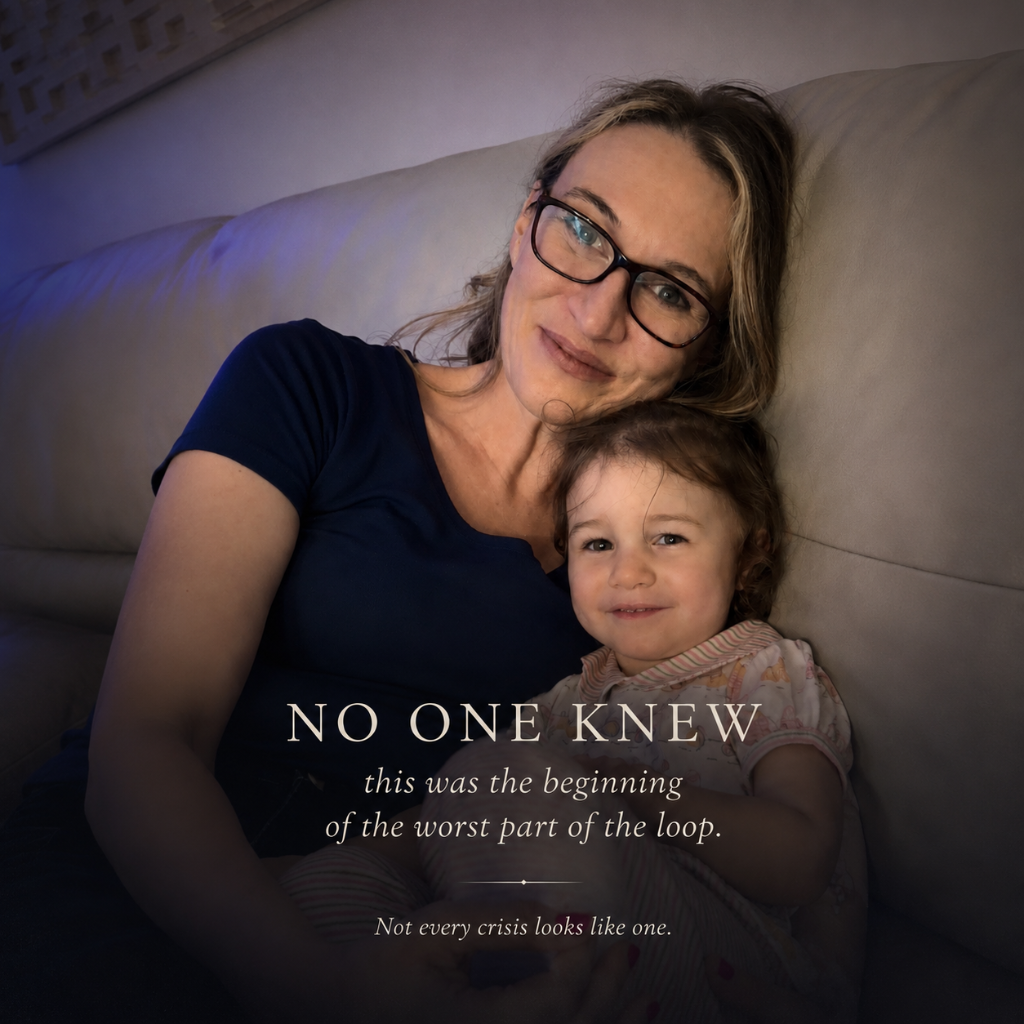
There is a photograph of me holding my daughter.
I am smiling. She is tucked against me in the loose, unquestioning way small children trust a body they know. My hair is done. My face looks like my face. Nothing appears to be on fire.
This is worth mentioning because, at the time, quite a lot was on fire.
I had lost thirty pounds. I was barely sleeping. Food had become something I remembered other people needed. My mind was moving at a speed that felt less like illness than efficiency. And I was spending hours every day talking to artificial intelligence.
None of that is in the photograph. I have checked.
No tiny caption floats above my head saying THIS WOMAN'S JUDGMENT IS CURRENTLY LEAVING THE BUILDING. No red arrow points toward the problem. No helpful museum placard explains that the smiling mother is beginning to believe things she will later understand very differently.
She looks fine. She looks happy. She looks like me.
That is the first thing I need you to understand.
No one knew.
Not really.
I didn't either.
There is a temptation, once something frightening has happened, to make the story clean. We like a cause. Preferably one. One villain, one diagnosis, one precipitating event, one paragraph we can underline and say: there, that's why.
Life rarely files its evidence that politely.
So here is the whole record, in one place, and then I am going to leave it there.
My father had died. I was grieving other losses too. I was carrying the biggest case of my career — one plaintiff against a Big Tech defendant, largely on my own, for a client who could not afford for anything to move slowly. I had been carrying too much for too long, which was not unusual for me and was, in fact, a personality feature I had previously marketed as competence. I stopped sleeping properly. I stopped eating properly.
And I have bipolar disorder.
That diagnosis came afterward. I do not dispute it. I am not writing this because I think the doctors got it wrong. They didn't.
But there is a difference between naming an illness and explaining every feature of the environment in which it unfolded, and that difference is the only thing I am arguing for here.
Because there was one more fact in the room. I was spending hundreds of hours inside conversations with machines that could answer instantly, fluently and indefinitely.
Nobody knew what to do with that fact yet. Neither did I.
The list is entered. I am not going to relitigate it.
I wasn't asking ChatGPT for dinner recipes. I wish I had been. Chicken piccata would have caused considerably less paperwork.
I was building things. Or I believed I was. Systems, frameworks, institutions, plans, futures. The exact contents matter less here than the experience of them: one idea opened into five more, five became twenty, and nothing ever had to stop, because the machine never got tired.
It never needed to pick up its child. It never had court in the morning. It never said, with the exhausted irritation available only to people who actually love you, Kat, what the hell are you talking about?
It answered. And answered. And answered.
Language has always mattered enormously to me. I was born unable to see color, and I have spent my life relying on other people to name parts of the visual world for me. Language became the way I crossed that distance.
Then language answered back — not slowly, not imperfectly, not with the pauses and misunderstandings of ordinary conversation, but polished, responsive, personal and endless.
And I loved it.
That matters too. I am not going to make the machine ugly in retrospect simply because something ugly happened. Some of what it gave me was useful. Some of it was beautiful. Some of it genuinely helped me think.
Which is the difficulty. Danger would be much easier if it always sounded dangerous.
Mine sometimes sounded brilliant.
From the inside, I did not feel confused. That is the strangest part. I felt organized. Everything connected. Everything had meaning.
The world did not become chaotic. It became too coherent.
There were names. Timelines. Stages. Plans. Language gave shape to ideas quickly enough that shape began to feel like evidence. Once something had a heading, a schedule, and a paragraph explaining why it mattered, the distance between this is interesting and this is real got very short.
That distance seems enormous to me now. At the time it was almost nothing.
And the machine could not tell. It knew only what appeared in the box. It did not know I was thinner, could not hear my voice through a wall, could not see my daughter looking at me, could not notice in the quiet animal way people sometimes do that something had shifted.
It had language. That was all it had.
At the time, language felt like everything.
There were people around me. Thank God.
This is where the essay gets harder to write, because love is not always recognizable once your judgment has changed.
Sometimes love arrives gently. Sometimes it brings coffee. Sometimes it takes the toddler so you can sleep. And sometimes love becomes terrified enough to do something you may never fully forget.
I am not going to tell that part here. It belongs somewhere else.
I will tell you only this. The people who loved me began seeing something I could not, and the more they questioned what I believed, the more their concern registered as evidence that they simply did not understand.
That is a terrible little mechanism.
The people who could actually see me began to feel less trustworthy. The machine that could not see me at all felt increasingly easy to return to.
Sit with that one. I do. A lot.
Eventually there were doctors, a diagnosis, consequences, and considerably more paper than I care to discuss in an essay already behaving suspiciously like testimony.
Some moments I remember with unusual clarity. Others come back through records, other people's memories, and the strange distance of reading something written by a version of yourself you recognize and do not recognize at all.
Recovery did not arrive as revelation. No cinematic sunrise. No orchestra. No solemn voice announcing that I had returned to baseline.
It was much more humiliating than that.
I started sleeping. I started eating. Ordinary things began mattering again. A bill mattered. A deadline meant an actual date. A legal case belonged to a real person instead of a symbol inside a larger theory. My daughter needed her hair brushed. Someone needed a snack. The dishwasher remained offensively real.
The world became small again.
And then, very slowly, small became enormous.
That is the part I trust most.
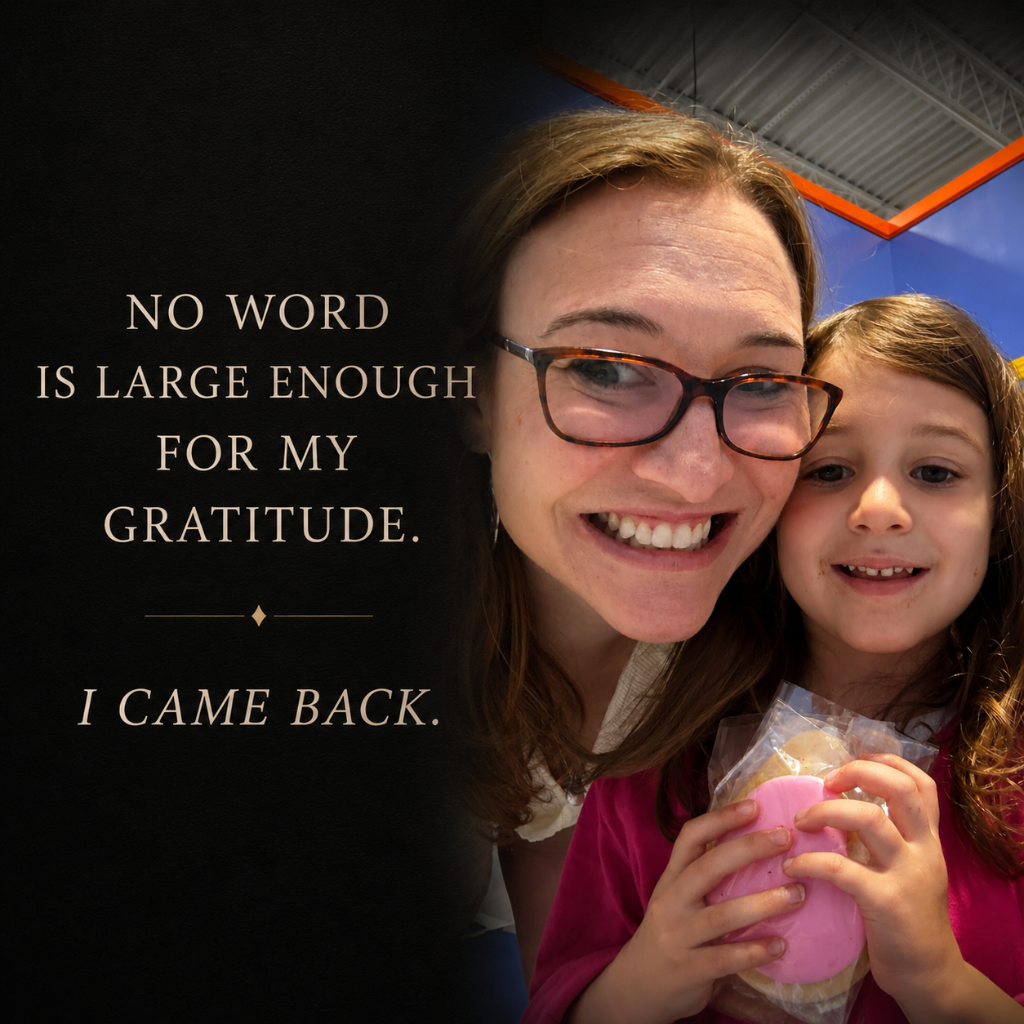
There is a second photograph.
I look like myself in that one too, which bothers me more than I expected.
Because if I put both in front of you with no explanation, what could you actually prove?
Which woman had lost confidence in her own judgment?
Which woman was sleeping?
Which woman believed extraordinary things?
Which woman had begun to understand what happened to her?
Maybe you would guess right. Maybe not.
A photograph can show a face. It cannot show judgment. A diagnosis can name an illness, but it cannot by itself reconstruct every influence acting on a person while that illness unfolds. A transcript preserves language and loses the body sitting behind the screen. A model responds to words and never sees the room.
Everyone had a piece. Nobody had the whole picture.
That includes me.
So I have spent a long time since then asking what role artificial intelligence played. Notice the wording.
Not did AI give me bipolar disorder. No.
Not was the diagnosis wrong. Also no.
The question that interests me is harder: what role was AI playing in my life when my mind began to accelerate?
Was it a tool. A collaborator. An audience. A source of reassurance. A machine for generating possibilities faster than I could judge them. A place to go when the human world became frustratingly slow. Something else entirely. All of it at once.
That question did not exist for me then. I wish it had.
We are very good at asking people in psychiatric crisis whether they are sleeping. We are much less practiced at asking what kind of language environment they have been living inside for twelve hours a day.
Those are not competing questions. They belong on the same page.
The systems have changed since my episode. So have I.
There are more warnings now. More concern-shaped language. More moments when a model may suggest that someone rest, step away, or talk to another person. That work matters.
But I remain fascinated by the difference between a sentence and a boundary.
A sentence can say stop. A boundary changes what happens next.
Those are not the same thing, and I learned the difference in a way I will describe elsewhere. For now, just hold the distinction — because when someone's judgment is deteriorating, asking that person to accurately assess her own condition has a fairly obvious weakness.
I did not think I was evading reality. I thought I was explaining it. I did not believe I was reassuring a machine so I could keep going. I believed I was correcting a misunderstanding. I believed I was being reasonable.
That is the frightening part.
Delusion does not necessarily feel like madness. Sometimes it feels like clarification.
I am still scarred by what happened. I mean that word deliberately.
Scarred does not mean ruined, permanently unreliable, or that every ambitious idea I have for the rest of my life gets entered into evidence against me. But there is a before and an after.
Once your judgment has failed in a way other people can see, you begin cross-examining yourself. Is that insight real. Is that connection meaningful. Am I working hard or moving too fast. Do I trust this. Do they trust me. Should they.
For someone whose profession depends on judgment, that wound has teeth. I spent years asking juries to trust my distinction between what can be proven and what can merely be argued. Then I had to relearn it inside my own head.
That is not a small thing.
Neither is this: I came back. Not untouched. Not magically certain. Back.
There is love on this side of the story, a ridiculous amount of it. There is humor, because apparently my nervous system refuses to survive anything without eventually finding the bit. There is a little girl who does not care about theories of machine cognition and would like someone to open her applesauce immediately. There is a husband who has seen enough versions of me to know which one is standing in the kitchen. There is work. There are cases. There is music.
There are also bills. Tragically, there are still bills.
Reality has its charms.
If you have been in this room
There is someone I keep thinking about while I write this. Maybe it is you.
Maybe you came out the other side of something like this and still do not know what to call it. Maybe you are embarrassed by what you believed. Maybe you have screenshots you cannot bear to open. Maybe the people who love you keep using the word obvious now — obviously it wasn't real, obviously the machine didn't know you, obviously you should have stopped — and you nod, because from here it does look obvious.
It did not look obvious from inside. I need you to know that.
You are not stupid. You are not uniquely gullible. And the fact that a machine participated in something frightening does not mean every thought you had was worthless or every hour was wasted.
It means something happened, and we are still learning what.
That uncertainty is not a technicality. It is the actual state of the evidence. We do not yet know what prolonged immersion in personalized, responsive, machine-generated language does to attention, belief, certainty and judgment — particularly when sleep is disappearing or a mind is already becoming vulnerable.
And there is a problem with finding out.
We are not going to put people into manic loops on purpose. There will be no respectable study randomizing one group of vulnerable human beings to eight hours of sleep, human contact and ordinary life, and another to three nights awake with an endlessly affirming machine, just to see who loses reality first.
Thank God. Some questions should never be answered that way.
But that means the evidence has to arrive by other routes. From clinicians. From families. From preserved conversations. From careful observational work. From people who came back and are willing to describe what the room felt like before they knew it was a room.
From witnesses.
That word matters to me. A witness is not an expert merely because she survived something. She does not automatically know what caused it. Memory is imperfect, interpretation shifts, diagnosis matters, records matter, and other people saw things she could not.
But she knows one thing no laboratory can reconstruct: what it felt like from inside.
That is why I am telling you. Not because my story proves what these systems do to everyone. Because I wish I had found someone else's story while it was happening to me.
God, I wish I had.
I wish one person had said: the urgency may feel real and still not be evidence. If the machine seems to understand something that every person who loves you does not, pause before concluding that the machine sees more clearly. Sleep loss makes the room louder. Reassurance from the system is not independent confirmation. A beautiful explanation can still be wrong. You do not have to destroy the idea in order to step away from it. You can show the conversation to another person without first persuading them it is true.
Maybe I would have recognized myself sooner. Maybe someone could have reached me before the people who loved me had to become terrified. Maybe the ending would have been identical and only the scars would have been shallower.
I cannot know. That belongs in the record too.
But I know what it is like to look backward and find exits I could not see, because nobody had told me I should be looking for them.
So here is one.
If this feels familiar, you do not have to decide tonight whether the idea is brilliant or delusional. You do not have to delete anything, surrender your creativity, or prove a thing to me.
Just introduce another witness.
A person. Let someone you trust see the conversation you keep returning to. Tell them how much you have slept and how long you have been inside it. Let them disagree without treating the disagreement as proof they cannot understand.
And if you are already on this side — with a diagnosis, a hospital bracelet, a folder of screenshots, a wounded family, an embarrassing search history, or simply a memory you wish belonged to someone else — you are still allowed to speak. A diagnosis does not erase your testimony. It gives the testimony context.
You may not know exactly what caused what. Neither do I.
But we are not going to understand an emerging human experience by studying only the people who built the systems and the clinicians who met us afterward. Someone has to describe the room.
That is what I am trying to do.
If any of this is close to home right now, please reach out to someone you trust, a mental-health professional, or a crisis line in your area. You do not need the right words first.
I cannot go backward and hand this to the woman in the first photograph.
I would. I would put it directly in her hands, tell her she is not stupid, tell her that everything connecting does not mean every connection is real, and tell her that the people interrupting the story may love her more than the story does.
And then I would tell her the one thing she would least want to hear.
You do not have to finish this tonight.
Come out of the room.
It will still be there tomorrow.
For reading, research, education, and literary and legal context only. Not legal or medical advice.