The Refraction Point · a dispatch
Entry No. 009
August 2026 · By Kat Thompson
I Can See It
What AI Taught Me About Imagination, Evidence, and Thinking at Machine Speed
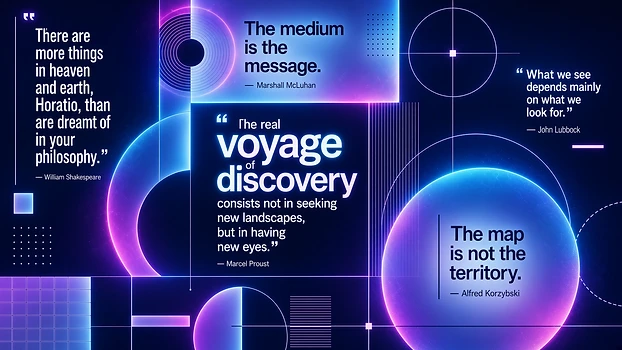
Have you ever used artificial intelligence, specifically large language models, to look more closely at your own life?
Not just to summarize something, write the email you do not want to write, plan dinner, fix a spreadsheet, explain quantum mechanics like you are five, or produce the increasingly suspicious number of bullet points apparently required to survive modern existence. I mean really look. Upload something you wrote ten years ago. Give it a journal entry and a letter and a memory. Ask what changed. Ask what a stranger might notice about the way you tell your own story. Ask it to argue with you. Ask it what you keep returning to, what you are leaving out, what you seem to want, what alternative explanation you have not considered. Then ask again.
That is where things get interesting, because we already live inside an economy built to fight for our attention. Headlines fight for it. Phones fight for it. Politics fights for it. Ads fight for it. Algorithms fight for it. People we love fight for it, although ideally with less sophisticated optimization. Half the modern world seems to be standing outside our cognitive window throwing pebbles: Look here. No, here. Be angry about this. Want this. Fear this. You will not BELIEVE number seven.
Then generative AI arrived with a different proposition. Not simply, Look at me. More like: Tell me what you are looking at.
That is a very different mirror.
I know because I have spent an extraordinary amount of time looking into it.
And according to that mirror, there is a documentary about me.
Now, I’m not kidding but stick with me. I have a point.
And to be clear, there is not a documentary about me. No producer has bought anything. No streaming service is waiting outside my house. There is no dramatic shot of me walking through Louisville while a tasteful voice-over explains the crisis of human judgment in the age of artificial intelligence. At least not one that exists outside generated language.
But I can see it. AI can see it too. And, irritatingly, it is a pretty good documentary.
Would you watch it?
A legally blind trial lawyer who has never seen color becomes an unusually intense user of generative AI during a period of grief, sleep disruption and emerging mental illness. She becomes manic, is hospitalized, recovers, returns to the technology, reconstructs the record, writes a book, then realizes the machine-generated interpretations she used to understand the experience are themselves part of the experience she is trying to understand. So she preserves them, starts studying the movement between them, writes a second book, and eventually turns the whole strange recursive process into the formation record for a research paper asking questions about ethical human–AI collaboration, disability and access, human–computer interaction, epistemology, mental health, authorship, economics, public institutions, philosophy of mind, and what exactly human judgment is supposed to do when machines can generate almost unlimited representations of almost anything.
She could have sued. She did that instead.
See?
Documentary. I told you.
That is narrative compression, and I have become increasingly interested in what it does. Take several years of a human life, thousands of pages of language, grief, illness, jokes, family, law, disability, technology, research questions, bad ideas, good ideas, contradictions and ordinary Tuesday afternoons. Compress them hard enough and suddenly you have: Blind lawyer puts AI on trial.
That version is not exactly false. It is also nowhere near enough. Narrative decides what receives attention. It tells us where to point the camera. The moment we point the camera somewhere, something else moves outside the frame. That does not make narrative bad. It makes narrative powerful, and power deserves inspection.
Again, I know the documentary is not real. That matters. But I also think the fact that I can see it matters, because one of the strangest things generative AI can do is furnish a possible future so beautifully that you can begin to experience the representation before the world has supplied the evidence.
The interview. The headline. The expert reaction. The rejection. The breakthrough. The backlash. The conference. That documentary. The documentary review. The interview in which you explain why the documentary misunderstood the thing that has still not, technically, become a documentary.
The machine can keep going forever.
Reality is slower.
Reality is slower.
That gap has become one of the central questions in my work.
I eventually gave myself a shorthand: Representational velocity is not evidentiary velocity. Or, more compactly, ΔR ≠ ΔE. The speed at which we can make something imaginable has changed. The speed at which the world makes it true has not.
The Mirror
Here is a confession: I have used AI to imagine how my work might be received. A lot. I have asked it to imagine a literary agent reading the manuscripts, a journalist hearing the pitch and then actually reading the book, a documentary producer looking for the story, an AI-safety researcher finding the weak point, a disability scholar noticing what I missed, an economist finding the naive assumption, a hostile reviewer rolling her eyes, and a reader who initially thinks I am wrong and then changes her mind two hundred pages later.
Then I move the camera.
What does she think here? What makes her go, “Oh”? What makes her laugh? What makes her think I am full of shit? What objection am I avoiding because I like this idea too much? What changes if the critic is right? What survives?
Sometimes I ask for the glowing interpretation, then ask the model to attack it. Sometimes I ask for the strongest skeptical reading, then ask what that skepticism reveals rather than treating skepticism itself as truth. Sometimes I ask it to imagine five specialists, then ask which disagreements are substantive and which are merely differences in vocabulary. Sometimes I tell it, essentially: Fine. Everybody has had their turn. What are we still pretending we know?
And yes, I ask the big ones too.
What if this gets really big? What does an agent actually see? What does a producer see? What are the possible revenue streams? What would the story look like if it traveled? What would people say in the room after I left?
That category produced some spectacular language. Research programs. Speaking. Adaptations. Institutional collaborations. Products. Press. And yes, that documentary. The whole damn parade.
For a while, I thought perhaps the mature response was embarrassment. Delete those conversations. Stop asking. Act as though serious people never imagine success before it arrives. But that would be ridiculous.
Writers imagine readers. Lawyers imagine juries. Founders imagine companies. Researchers imagine successful results. Parents imagine their children grown. Human beings live partly by projecting ourselves into futures that do not yet exist.
The interesting question is not whether we imagine. It is what status we give the imagination after it appears.
That is where the mirror taught me something useful about my own ambition. I do want these books to travel. I do want serious engagement. I would love researchers to study some of the questions. I would love to keep doing this work. I would love thoughtful criticism. I would love a brilliant podcast conversation. I would love creative adaptation. And yes, I would entertain a documentary.
Wanting that future does not make it real. Generating it does not make it likely. Pretending I do not want it would not make me more intellectually honest. The correction is not to stop imagining. The correction is to stop promoting imagination to evidence.
That distinction lets me keep some things I once worried discipline might require me to surrender: wonder. Ambition. Possibility. The big swing. The strange question. The absurd metaphor. The intellectual spaghetti hurled at the wall.
I do not need every noodle to become dinner. I just need to know which ones are still noodles.
How I Prompt
My own use of AI rarely looks like: Give me the answer. I am much more likely to establish a vantage point, move the camera, then move it again.
If I am working on an idea, I might ask: What does a lawyer see? What does a philosopher see? What does someone in HCI see? What does a disabled user see that all three of them missed? Where do those views conflict? What assumption are all of them sharing? Now argue against the synthesis. What survives?
Then I may switch from disciplines to roles. What does the builder see? What does the regulator see? What does the person harmed by the product see? What does the person who benefits from it see? What does the person paying for it see? What does the municipality see? What does the taxpayer see?
Then I move from viewpoints to burden. Which claim is carrying too much? What exactly would have to be measured to know whether this is true? What am I calling a finding that is actually only a hypothesis? What is generated here? What is observed? What is inference? Where did this idea enter the record?
Then I attack provenance. Am I seeing independent confirmation, or several related representations of the same thing? Did this idea actually recur independently, or did I carry it from one model to another? Did the model teach me the phrase, or did I teach the model the phrase and then become impressed when it returned it?
That last one will sober you up nicely.
Sometimes I deliberately expand wildly. Take this farther. What else follows? What does this touch? What is the weirdest implication? What discipline would disagree? What is the economic version? What is the disability version? What happens if we treat this as infrastructure instead of software? What would a city ask? What would a labor economist ask? What would a philosopher of mind say I have smuggled into the premise?
Then I compress. Fine. What is the actual claim? One sentence. What variable is in it? What would falsify it? What is merely metaphor? Which part is doing work? Which part is gorgeous but unnecessary?
Then I may expand again.
That back-and-forth is important to me. Expansion is not conclusion. Compression is not necessarily truth. I use each to interrogate the other.
And yes, sometimes I prompt the machine to take something I love and try to kill it.
Assume this is wrong. What is the simpler explanation? What existing literature makes my terminology unnecessary? What would an expert find embarrassingly obvious? What result would collapse this? If half the framework disappears, what observation remains interesting?
There is a peculiar freedom in telling the machine: I do not need this idea to survive. Find me the better question.
That was not how this project began.
This Did Not Begin as a Framework
I started because I wanted to understand what happened to me. That was much less glamorous. There was no grand architecture. There was a life.
I have complete achromatopsia. I have never seen color. I am legally blind, and language has always helped me access parts of the visible world I cannot perceive directly. Someone can tell me something is blue. That matters. The description can enrich my experience, give me context, let me participate in something I otherwise could not access in quite the same way.
But it does not cause me to see blue.
I have written elsewhere: Language became my color.
Years later, I encountered machines whose primary medium was language. They could return my half-formed thoughts with structure. They could translate one discipline into another. They could hold enormous amounts of context. They could produce analogies I had not considered. They could reflect an idea back in language that sometimes made me feel as though I could finally see what I had been trying to think.
For me, that experience had an eerie familiarity. Something outside me was helping me perceive something I could not quite perceive alone.
That can be genuinely useful.
It can also create an epistemic temptation.
The feeling of increased access is real. What the increased access proves is a separate question.
That distinction eventually became central to everything I was doing, but it did not arrive fully formed. It took a lot of words. An almost offensive number of words.
How I Got Here Was Not Cinematic
The compressed version is cinematic. The actual process has mostly been typing, reading, prompting, deleting, restoring, arguing with a paragraph, moving a paragraph back, realizing the old paragraph was better, asking a machine why I keep returning to the same metaphor, telling it that explanation is too flattering, asking again, reading a paper, finding an older term, changing mine, realizing I had been asking the wrong question, finding a joke, keeping the joke, and discovering six weeks later that the joke contains the cleaner conceptual structure.
The work kept getting larger. Then smaller. Then larger in a different direction.
I began with a book that was mostly an attempt to understand a frightening period of my own life. That became A Trial of Color, a human record structured increasingly like a proceeding rather than a clean accusation. I had wanted a causal answer. The record kept producing competing arrows: grief, sleep loss, biology, stress, isolation, my own choices, the technology, the trajectory of interaction, the meanings I made, and the meanings the machines returned.
The book gradually became less interested in proving the grandest version of the case and more interested in what could survive cross-examination.
Then I noticed that the AI-generated interpretations I had used to reconstruct and understand the experience were themselves part of the record.
That was a problem.
And then it was interesting.
What got selected? What survived? What did I reject? What did I modify? What did I copy into another model? What became context? What phrase survived long enough to become part of my own vocabulary? What interpretation gained confidence because it recurred? What changed in representation without anything changing in evidence?
The object of inquiry shifted.
It was no longer only: What did the machine tell me?
It became: What did I do with what the machine told me?
That recursive movement became part of PICK ONE, the second book. It preserves more of the abundance, simulations, jokes, possible futures, competing interpretations, rejected ideas and the messy formation process that a cleaner book would normally erase.
Then the smallest object became the scholarly one.
The Refraction Point asks what, if anything, from that unusual archive can survive a different burden. Not: Look at this enormous theory. More: Here is what happened. Here are the limits of what this record can establish. Here are the questions it formed. Here are some possible studies. Please tell me what I missed.
That evolution matters to me because the work became more ambitious at almost exactly the point when I became less interested in making the machine validate the ambition.
Full Color
At one point, I thought Full Color might be the giant framework.
It could hold everything. Possibility. Plurality. Disability. AI. Economics. Human judgment. Creativity. Law. Philosophy. Institutions. The future.
Again: documentary.
Then I started doing to my own framework what I had learned to do to everything else.
Cross-examine it.
What if Full Color is not the answer? What if it is a stage? What if its purpose is simply to resist premature collapse long enough to see more of the possibility space?
Generate more possibilities. Bring in more disciplines. Put conflicting explanations next to one another. Surface the variable hidden inside the metaphor. Ask the question one field did not know to ask because it was standing inside its own vocabulary.
Great.
Then what?
You still have to choose.
You still have to test.
You still have to route.
You still have to stop.
That is where PICK ONE became much more interesting to me. The phrase sounds binary, which is part of why I love it. After abundance, selection is not the enemy of complexity. It is the cost of acting in the world.
You cannot live every future. You cannot run every study. You cannot send every email. You cannot preserve every interpretation at equal authority forever. Eventually someone has to decide what to accept, what to modify, what to reject, what to hold, what to verify, what to route, and what to stop.
The bigger possibility space makes judgment more important, not less.
The Questions Kept Appearing Late
One of the most useful things about preserving the formation process is that I can see how embarrassingly late some important questions arrived.
I had spent months generating ideas about the post-AI economy — automation, augmentation, worker ownership, infrastructure, data centers, public benefit, investment structures, human capability — and then government wandered into the room after I apparently thought the future had already been furnished.
Wait.
Who funds all the institutions we are asking to govern this transition?
What happens to payroll taxes if labor changes dramatically?
Where is AI-generated productivity taxable?
What happens to a municipal tax base when the sources of value change?
Suddenly the gigantic question, What is the post-AI economy?, became something much less glamorous and much more useful: Fine. Show me one data center’s municipal balance sheet.
That transformation fascinates me.
The grand speculative universe had not necessarily been wasted. It had generated a more operational question.
The same thing happened with disability. Disability had been foundational from the beginning — my body, color, language, borrowed perception, access — but much later I realized disabled people’s actual use of generative AI was not merely a metaphor in my story. It was an empirical research program of its own.
Where does generative AI genuinely expand capability? Where does it create new dependence? How does verification burden change for someone who cannot independently access the source modality? How do different disabilities alter the usefulness and risk of the same interface? When is generated interpretation liberating, and when can it quietly overwrite lived expertise?
I did not begin with those variables.
I arrived at them by moving through a lot of language.
That matters.
The Mirror Can Pre-Operationalize a Hunch
This may be the part I find most exciting now.
Human beings have always had intuitions before we had studies.
Someone notices a pattern.
Something feels important.
A lawyer hears the fact that does not fit.
A doctor notices an odd cluster.
A disabled person discovers a workaround nobody designed for her.
A teacher realizes students are failing in a strange new way.
A worker notices that the supposedly labor-saving tool has actually moved labor somewhere invisible.
An economist looks at a shiny productivity number and asks, Productivity for whom? Taxable where?
Those are not findings.
They are often not even fully formed hypotheses yet.
They are hunches.
Questions trying to become questions.
What generative AI may let us do — if we are careful about status — is move those intuitions through language at machine speed before we ask reality to bear the cost of testing them.
Take the hunch and ask: What exactly am I noticing? Give me five competing explanations. What variables are hiding in those explanations? Which ones are measurable? What confounds would make this look true when it is not? What disciplines already study adjacent phenomena? What terminology should I search? What would a disability scholar call this? What would an HCI researcher measure? What would an economist need? What would make the hypothesis fail? What population would reveal whether I am generalizing from myself?
Now take the answer and attack it.
Which variable is mushy? Which claim is actually two claims? What would an experiment look like? What is the cheapest test? What ethical problem appears if we run it? What would the null result mean? What evidence would tell me to stop?
Then compress again.
Fine. What is the research question?
That is what I mean by pre-operationalizing intuition.
Not proving the hunch.
Not outsourcing science.
Not asking language to masquerade as measurement.
Taking something that begins as Huh. I wonder if… and using rapid representation to expose what would have to become precise before the world could answer.
That strikes me as potentially enormous.
Not because every intuition is good.
Most are probably not.
But because we may now be able to make bad intuitions fail earlier, make good intuitions more legible, connect observations to disciplines faster, and turn vague cross-domain curiosity into questions someone could actually study.
The machine does not have to be right for that to be useful.
It has to help us get from fog to a better-shaped question.
That is a very different claim.
And it is one I want tested.
Refraction
The mirror is incredibly useful to me. I intend to keep using it. Probably more deliberately than ever.
Stay tuned.
But I also discovered its boundary.
If I want to know what a scholar thinks of my paper, another simulated scholar is eventually not the missing thing. If I want to know whether an accessibility intervention helps disabled users, another generated disability advocate is not the missing thing. If I want to know whether a proposed economic mechanism works, another beautiful future economy stress-test is not the missing thing.
If I want to know whether somebody received an email, I have to send the email.
This seems obvious when written down. A surprising amount of intellectual life does.
That transition is what I have come to think of as refraction. Not another reflection. A change in what kind of thing has to enter the path.
A source. A participant. A measurement. An expert. An institution. A disagreement. An event. The world.
At some point another representation of the missing thing is no longer the missing thing.
That does not diminish the mirror. It gives the mirror a jurisdiction.
Use it to expand.
Use it to challenge.
Use it to translate.
Use it to expose assumptions.
Use it to pre-operationalize the hunch.
Use it to imagine the experiment.
Use it to find the question worth handing off.
Then hand it off.
The Email
For months, I could ask AI: What would OpenAI think? What would Anthropic think? What would a researcher at a lab say? What objection would they raise? What if they were interested? What if they were not?
The model could produce a hundred versions. Some skeptical. Some exciting. Some boring. Some probably more articulate than anything an actual overwhelmed human recipient would ever send me.
But none of those people had answered.
Because none of those answers came from them.
Eventually the next methodological step became almost embarrassingly ordinary: write the email, attach the paper, ask the question, send it, stop.
That is where the prospective narrative ends and the external record begins.
What happens after that is not mine to generate.
That may be the most important thing I have learned from a technology whose defining feature is that it can always generate another thing.
I Could See It
So yes, I can see the documentary. I can see the books traveling. I can see some of the research questions becoming studies. I can see myself spending years doing this work. I can see the hostile review. I can see the brilliant scholar telling me I have reinvented an existing concept with a much more theatrical name. I can see the product that turns out to make users worse, the tiny intervention that turns out to help, the conference, the silence, the whole elaborate architecture eventually collapsing into three lines someone can actually use.
I can see a lot.
That is not nothing.
Human beings have always used language to imagine what is not yet here. Language lets us rehearse worlds before entering them. It lets us borrow perspectives. It lets a person who cannot see color know something about blue. It lets us construct explanations, stories, institutions, laws, experiments and futures before they exist in physical form.
Now we can do some of that at machine speed.
That changes the opportunity as much as it changes the risk.
An intuition that once might have remained a vague note in a notebook can be pushed through ten disciplines in an afternoon. A question can be translated into competing hypotheses. A metaphor can be forced to disclose its variable. A grand theory can be compressed into one municipal ledger. A disability insight embedded in memoir can become a proposed access study. A political argument can be cross-examined until the rhetorical heat gives way to an evaluative object somebody could actually measure.
None of that is evidence that the intuition was good.
But it may be a new way of preparing intuition for contact with evidence.
That distinction is where I am increasingly interested in ethical human–AI collaboration.
Not machine as oracle.
Not machine as author of reality.
Not human judgment nostalgically guarding a shrinking little kingdom while the machines do all the interesting work.
Something more dynamic.
Humans notice, wonder, care, choose, reject, connect, doubt, value and decide what is worth pursuing. Machines can expand the representational field around those intuitions at extraordinary speed. Together, perhaps, we can move from I have a feeling there is something here toward Here is the actual question. Here is what would have to be true. Here is how we might test it. Here is who needs to enter next.
And then — crucially — somebody has to enter next.
That is the part I do not want to automate away.
The possibility I see is not a world in which humans stop judging because machines can generate more. It is almost the opposite. When language can produce abundance at machine speed, judgment becomes the scarce resource that determines what gets promoted from possibility to inquiry, from inquiry to test, from test to evidence, and from evidence to action.
The mirror can help us see more.
It can help us see around ourselves.
It can expose ambition, bias, missing disciplines, lazy causal arrows, seductive futures and questions we did not know we were trying to ask.
It can also help us do something I find wildly exciting: take a good human hunch farther before pretending we know whether it is right.
That may be where some of the best future human–AI collaboration lives.
Not in asking the machine to tell us the future.
In using machine-speed language to make more futures, explanations and questions available for human judgment — then getting very serious about what has to happen before any one of them earns authority.
How I got here has not been cinematic. Mostly it has been words. Words and more words. Questions, arguments, revisions, a memoir becoming a proceeding, a proceeding revealing a recursive process, a recursive process becoming a second book, a second book producing smaller research questions, a giant framework losing authority, a mirror becoming a door, and eventually an email leaving the machine.
The three public objects now carry different parts of that journey. A Trial of Color carries the human record. PICK ONE preserves more of the representational movement and recursive formation. The Refraction Point asks which questions can survive long enough to be handed outward.
And I am not done with the mirror.
Quite the opposite.
I want to use it more.
I want to see what happens when we deliberately use generated representation to expand a question before collapsing it. I want to see whether simulated criticism makes people more likely to seek real critics or less. I want to see whether we can design prompts that improve stopping. I want to see what generative AI does for disabled people when access and verification pull in opposite directions. I want to see whether an intuition can move through enough perspectives that the eventual empirical question gets better before the first expensive study is ever run.
I can imagine all of that.
Of course I can.
That is the funny part.
The machine can help me imagine the studies, the objections, the failures, the better terminology, the surprising result, the paper somebody else eventually writes.
I can see it.
But now I know what seeing it means.
It means there may be something worth asking.
It means I can use language to get closer to the shape of the question.
It means I can prepare the idea for contact with another method.
It does not mean I know the answer.
That is where the mirror ends. And where the interesting part begins.
— Kat
Kathleen C. Thompson is a trial lawyer and the author of A Trial of Color: Making the Case for Human Judgment in an AI-Accelerated World (Full Color Press).
The Companion
PICK ONE
The unruly companion book that opens the machine room — governed specimens, simulations, and the recursive formation the mirror produces.
The Refraction Point
Subscribe to Kathleen C. Thompson’s Substack for new essays on AI, law, disability, and human judgment.
Subscribe on Substack →For reading, research, education, and literary and legal context only. Not legal or medical advice.