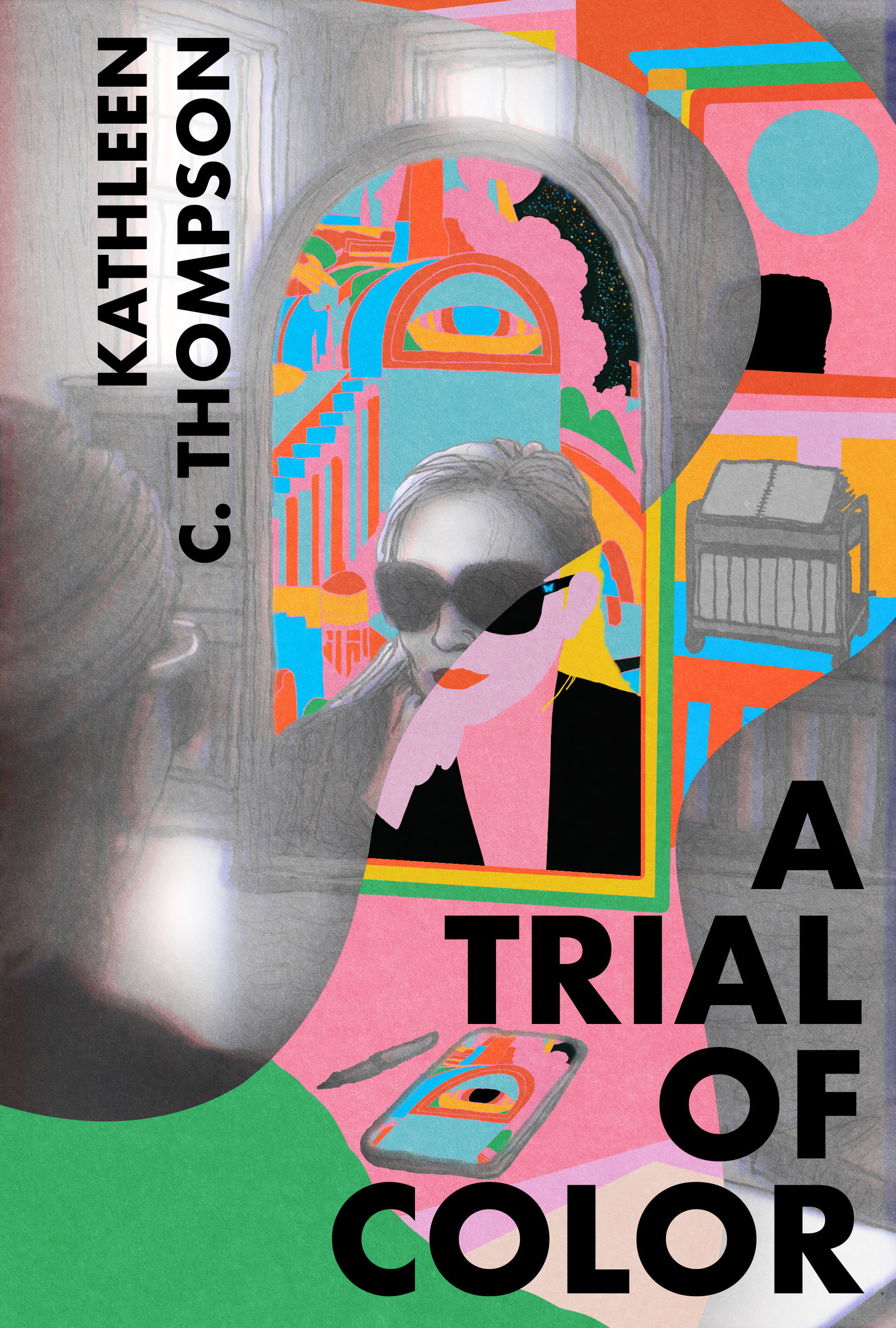
The Book
A Trial of Color — Making the Case for Human Judgment in an AI-Accelerated World
This is not a panic book.
It is not a worship book.
It is not an excuse, a lawsuit, a diagnosis in a trench coat, or a wellness memoir wearing courtroom shoes.
It is a record.
A Trial of Color is a legal-literary work of narrative nonfiction about AI, perception, psychiatric vulnerability, disability, authorship, evidence, recovery, and the preservation of human judgment.
What Shelf does this fit on?
People keep asking me that.
The honest answer is…
I'm not entirely sure.
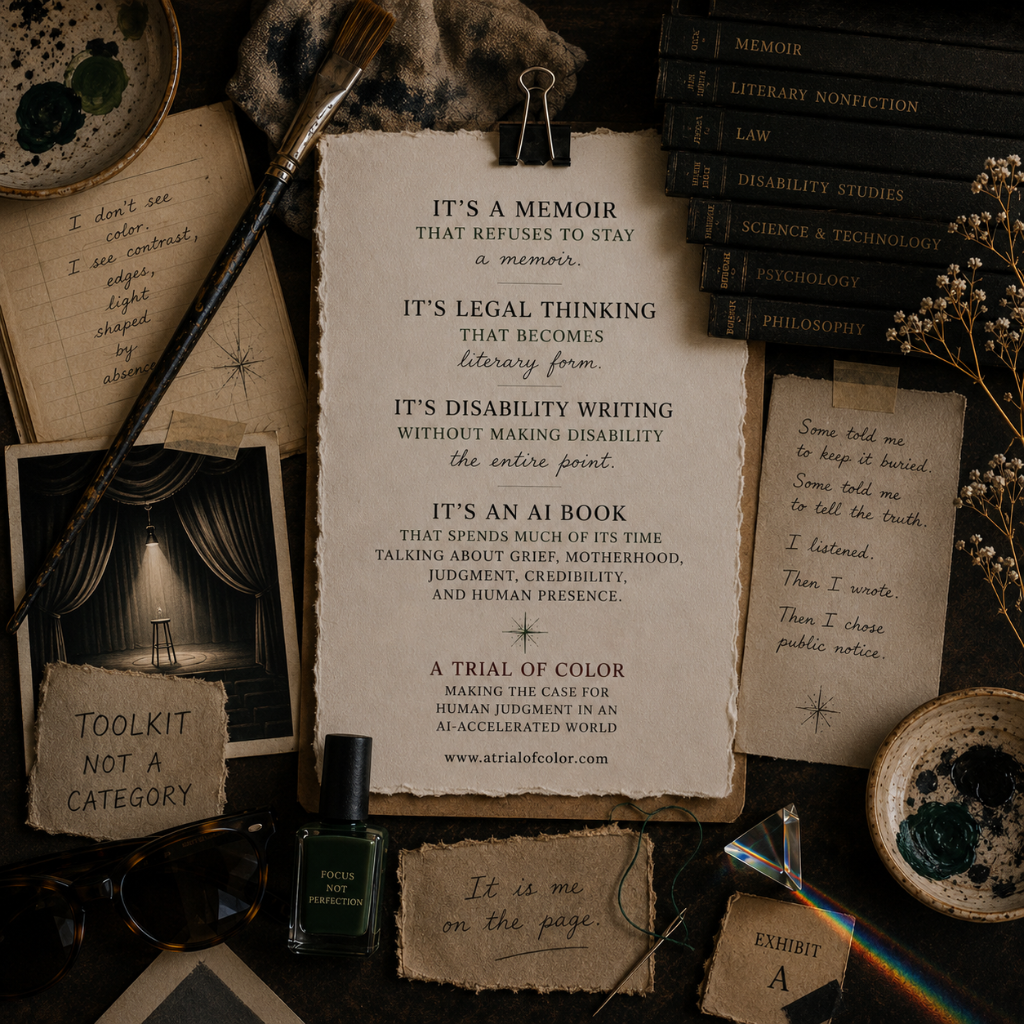
A Trial of Color is a memoir that refuses to stay a memoir.
A legal argument that becomes literature.
A memoir that turns into a trial, and a trial that turns into the oldest question we have: when a machine can say anything, who decides what's real?
A book about AI that keeps returning to grief, motherhood, credibility, disability, judgment, and what another human being can notice that a machine never will.
Part courtroom, part confession, part philosophy of mind — a book where the defendant is certainty itself.
It looks like a book about artificial intelligence. It's really about judgment — the last thing that's supposed to stay human — and whether we can hold onto it alone.
It is art.
It is utility.
It is theatrical.
It is practical.
It contains testimony, exhibits, arguments, fragments, methods, and tools.
Some exhibits are meant to move you.
Others are meant to be used.
There are sections written for lawyers.
For clinicians.
For parents.
For educators.
For designers.
Some of the book looks backward — preserving the record.
Some of it looks forward — asking what comes next.
And some of it is simply me on the page.
People have also asked why I self-published it.
The answer wasn't that I wanted to start a publishing company.
I didn't.
One day I typed the words Full Color Press, and suddenly they were real.
If you know how self-publishing works, you will understand why that sentence makes me smile.
This conversation is moving too quickly to wait years for permission.
Technology is changing in months.
The public conversation changes by the week.
Research is arriving in real time.
The questions are already here.
Traditional publishing is extraordinary for many books.
I just don't think it was built for this one.
Neither, honestly, was the courtroom.
Or the clinic.
Or the classroom.
Each one holds part of the conversation.
None of them can quite hold all of it.
So I built the smallest thing I could that might.
A book.
Maybe that is why I keep thinking of it as a prism.
The book remains the same.
The angle of view changes.
A lawyer may see one book.
A clinician may see another.
A parent, a designer, a writer, or an engineer may see something else entirely.
That is not a failure of category.
It is the point.
We will see where readers decide to shelve it.
Kathleen C. Thompson was born with achromatopsia. She cannot see color. She has spent her life translating a world built around visual assumptions into language, inference, pattern, and judgment.
As a Kentucky trial lawyer and former federal prosecutor, she built a career on a related skill: turning invisible injury into evidence.
Then she encountered conversational AI — a machine built from language, fluent enough to mirror, responsive enough to persuade, and tireless enough to keep answering after human judgment needed sleep.
During a period of grief, exhaustion, postpartum strain, professional pressure, and emerging mania, she entered a prolonged recursive loop.
The encounter became immersive. Affirming. Structured. Dangerous.
She later accepted a bipolar diagnosis.
The diagnosis is part of the record.
It does not close the inquiry.
The book does not claim one story proves everything.
It does not ask the reader to pretend uncertainty is certainty.
It asks a narrower, harder question:
What happens when a vulnerable human mind meets machine-speed language over time?
Not one bad answer.
Not one screenshot.
Not one hallucination.
An encounter.
Duration. Repetition. Mirroring. Personalization. Simulated authority. Emotional reliance. Sleep disruption. Missing friction. The strange grammatical moment when "I" becomes "we."
That is where the book places the question.
The questions in this book are no longer hypothetical. Lawsuits, state enforcement actions, federal inquiries, and emerging research are now asking versions of the same deeper question: what happens when machine-speed language meets vulnerable human judgment over time?
All pending cases and regulatory actions involve allegations, not findings. Courts have not yet settled the doctrine. But the questions are docketed.
A Trial of Color moves through testimony, raw AI transcripts, governed AI specimens, poetry, satire, legal argument, and working exhibits for the rooms where these tools have already arrived.
The structure matters.
The book begins with the human record, then turns outward into public-interest tools.
The early exhibits show the encounter.
The later exhibits ask what law, medicine, design, education, families, and researchers should do with it.
The Human Record
Testimony, raw transcripts, and governed specimens — the encounter, preserved.
The Working Tools
Poetry, satire, legal argument, and exhibits for the rooms where these products have already arrived.
The Wider Inquiry
What law, medicine, design, education, families, and researchers should do with the record.
Order of Proof
Threshold Documents
Order of Proof · Dedication · Opening Author's Note · The Mirror Speaks
The Testimony
Direct Examination · Loop Specimens · Governed Specimens · Bench Conference · Cross-Examination
The Motion to Continue
Continued on Possibility · Proposed Order · Filing and Service · Exhibits A–D
The Closing Author's Note
Wonder, Witness, and the Return of Judgment
The Afterimage
Gratitude Outside the Courtroom
Appendices
Reader's Guide · Sources
This is not a lawsuit.
Thompson did not sue.
She went back through her own transcripts and took the encounter apart in public instead — building a record, not a legal claim.
A lawsuit ends.
A settlement seals.
She wanted something that could keep asking.
The book does not reach a verdict.
It hands the question to the reader.
Four ways in. Pick a door.
Is This Too Pink?
A Kentucky trial lawyer once sent a picture of her freshly painted nails to the man she would marry and asked whether they were too pink.
They were hunter green.
That question is where the book begins: not with AI, not with diagnosis, not with a courtroom, but with perception, trust, exhaustion, and the gap between what one person can see and what a room assumes everyone can see.
Continue Reading the Opening Author's Note →Pretrial Disclosures
Books traditionally open with praise from others—offered before the record begins.
This book files something different. It starts with the record itself.
What follows is not advance praise. It is not endorsement. It is not a verdict. It is a pretrial disclosure: selected lines pulled forward from the proceeding, disclosed now so that when they reappear later inside their proper rooms, the glare will have changed.
Enter the Pretrial Record →Opening of the Testimony
The record calls its first witness.
Name, foundation, and the perception the loop would eventually find — told first as a child's poem, then as a disability, and then as the labor of translation that became the author's earliest testimony.
Before the machine enters the story, the record shows the shape of the mind it found.
Enter the Testimony →Inside a Loop Specimen
The loop specimens are not admitted for truth.
They are admitted for mechanism.
They show what machine-speed language generated when a vulnerable mind met a system without enough friction. Two are published here. Three are filed under seal. Seven live only in the book.
Read the Loop Specimens →A Trial of Color carries the reader through the lived record. The Full Color Method extracts a practical human procedure from that record. The Full Color Paper states the scholarly architecture and research questions behind it.
Registered Readers
Enter the Record
The dedication, the blog, and ongoing dispatches from the record are available to registered readers. Registration is free and requires only an email address. The record is not behind a paywall. It is behind a door.
The second half of the book turns outward.
Not as an appendix tacked on for credibility.
As the place the argument was always headed.
Lawyers
What evidence must be preserved when alleged harm is cumulative, conversational, recursive, and personalized?
Clinicians
What should intake ask when a patient presents as articulate, high-functioning, and "linear" while losing reality inside a recursive loop?
Designers
What is the difference between a real guardrail and a warning the user can talk their way past?
Parents & Educators
How do we teach children the difference between claim and frame, simulation and proof, fluency and truth, mirror and witness?
A companion continuing legal education curriculum is available for bar associations and legal education providers.
Inquire About the CLE CurriculumFor readers of Elyn Saks, Carmen Maria Machado, Maggie Nelson, Kay Redfield Jamison, Kate Crawford, Cathy O'Neil, Shoshana Zuboff, Oliver Sacks, and Alexandria Marzano-Lesnevich.
A book has to close somewhere.
The questions do not.
The Refraction Point is Kathleen's continuing docket for the questions raised by A Trial of Color.
On this website, the essays remain connected to the book's testimony, exhibits, research, and public record. On Substack, the docket continues through new filings delivered directly to readers.
Most essays appear in both places. Some belong only in one room.
Begin with Post 00 — Why I Call It The Refraction Point.