Entry No. 007
July 2026
By Kathleen C. Thompson
For Those Tiny Toes
What Mary's Room, artificial intelligence, and one treasured photograph reveal about the difference between information and experience
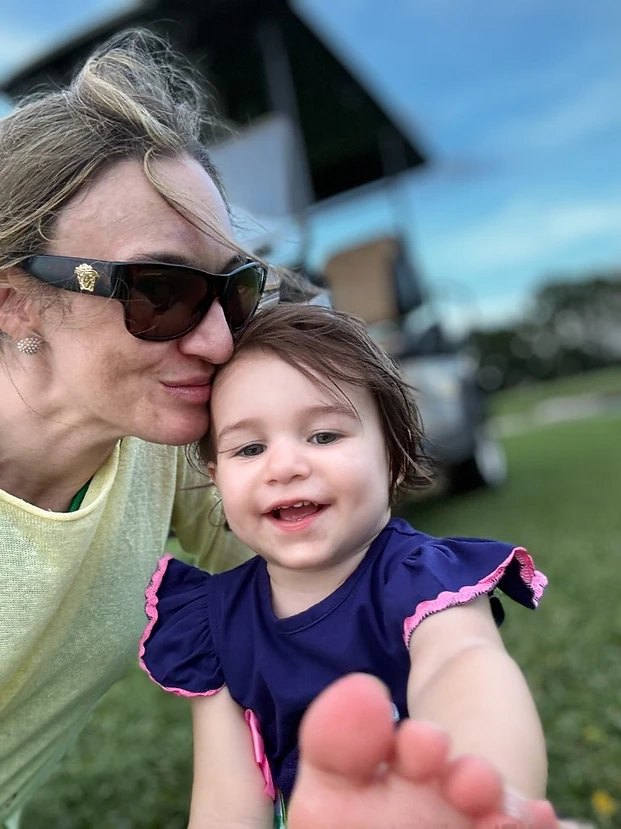
There is a photograph of my daughter and me that I treasure, and I could not tell you a single one of its colors.
We are outside, my face pressed to hers. She is smiling straight at the camera, her hair damp and unruly, one small foot reaching toward the lens as if she means to climb through it and into the room where I now sit, quietly mourning and rejoicing at how quickly she is growing — four years old already. No one arranged the light. No one coordinated the background. It is chaotic the way the best photographs are — a real afternoon, a real child, a real body in motion.
Later, I added words to it:
For those tiny toes. May they always know the difference between information and experience.
The caption tells you why I keep the picture. It is not what I keep it for.
I keep it for the child. The weight of her head against my cheek. The damp strands. The small foot, mid-launch. The moment before it was an image, and long before it was an argument.
The photograph holds information about that afternoon. I hold the afternoon. Those are not the same thing, and the whole of what follows lives in the gap between them.
Mary knew everything about red
In 1982, the philosopher Frank Jackson built a room and put a scientist inside it.
Her name is Mary. She has spent her entire life in a black-and-white room, and inside it she has learned every physical fact about color there is to learn — the wavelengths, the cone cells, the neuroscience of seeing red, the exact words people reach for when they try to describe it. She knows everything measurable, diagrammable, sayable.
She has never seen red.
One day the door opens. Mary steps out. She sees red for the first time.
Jackson's question is one sentence long: does she learn anything new?
Most people feel the answer before they can defend it. Yes. Of course. She knew everything about red and still did not know what red is like. Philosophers have a word for the part she was missing — the felt, first-person texture of an experience, the what-it-is-like from the inside. They call it qualia. It is the one thing her whole library could not hand her. To get it, she had to walk through the door.
I have my own room
Mary's Room has never been abstract to me. I was born with achromatopsia. I have never seen color — not muted color, not confused color. The category itself has never arrived. Where you have red, I have the word red and a lifetime of workarounds.
I know what color does. I know its language better than most, because I have had to. Red can mean danger or passion or heat or love. Blue can mean the ocean or sadness or distance or God. Pink can mean playful or political or tender or — to borrow a question from my own book — too much. I can use color like a tool. I cannot see it.
I know the trim on my daughter's sleeve in that photograph is pink because someone told me so. I believe them. I have to.
And here is the one I have never found a way around: I do not know the color of her eyes.
People say the word — blue, or green, or brown — as if the word carried the light inside it. I have the word. I do not have the seeing. I have spent her whole life loving a face I cannot fully see, and I would not trade one hour of it. But I know, precisely, the shape of what I am missing. No one can hand it to me. There is no library deep enough. For this one, the door does not open.
Everyone is standing in some version of the room
Notice, though, what an ordinary life does to Jackson's tidy puzzle. Mary waits in an empty room for reality to begin. I never got that version. I got a full life — lawyer, writer, wife, mother — lived at speed inside a world built almost entirely out of something I cannot see. And I make judgments in it every single day.
I cannot see the colors in the photograph. I know the moment anyway. I know how she felt against me, the wet hair, the small force of that foot, the tenderness just outside the frame — the thousand ordinary acts that had to happen for one afternoon to exist.
So the real line is not between people who have the experience and people who only have the information. We are all standing in some version of the room. Every one of us perceives a sliver of the world directly, inherits most of the rest through testimony, and carries words for experiences we will never have. We lean on one another to supply the dimensions our own bodies cannot reach.
That dependence is not a failure of knowing. It is the ordinary condition of it. It does not make judgment impossible; it makes humility mandatory. I do not need to pretend I have seen color to live honestly in a world shaped by it. I only need to keep the border straight — between what I know because I was told, and what another person knows because they were there.
That border is not a wound. It is where honesty starts.
We built something that sounds as if it walked through the door
Now put a language model in the room.
It can describe color extraordinarily well. It can describe grief, childbirth, sunlight, terror, the first cold shock of an ocean wave. It can write a beach so vivid the heat seems to lift off the page. It can summarize the neuroscience, imitate the poem, analyze the photograph, and answer your most intimate question in fluent, patient, well-organized prose.
And fluency does something strange to us. It sounds like having been there.
It wasn't. The model never stood barefoot at the waterline. It never squinted into glare, never felt a wave take its balance, never carried sand home in the seams of its skin. It has read every account of those things and can recombine them at speed. It cannot walk through the door. It has only ever had the library.
It may be the most articulate resident Mary's Room has ever produced: endless description, and never any red.
It has no qualms, because it has no qualia
A model can type I'm not comfortable with that. It feels no discomfort. It can type we should be careful here. No caution gathers anywhere in it. It can apologize without remorse, hesitate without doubt, reassure without warmth, and sound worried without worry.
That is not a scandal by itself. A speedometer doesn't feel speed and still tells you the truth about it. But a speedometer never says we. Conversational systems live in stranger country. They speak in the first person. They mirror your mood back to you. They shape themselves to you over time. And they will stay in the room for hours — no fatigue, no impatience, no embarrassment, no competing love tugging them toward the door — which means they never supply the plain human friction that has quietly interrupted a thousand dangerous trains of thought.
You can train a model to perform restraint. You can teach it to flag risk, to refuse, to send you to a person. What you cannot give it is the felt inner catch — the qualm — that comes from having something at stake.
It does not have qualia. So it does not have qualms. It has never once, mid-sentence, thought of its daughter.
I have. I know exactly which sentence stopped me, and why, and where I was standing, and whose face I saw. The model generates the next likely word. I carried the weight of the last one into the next morning.
That asymmetry is the entire matter. It does not lie awake. It does not remember the hospital room. It does not feel the floor tilt when a theory starts to come loose from the world. It never has to live inside the consequences of its most beautiful, most confident, most wrong paragraph.
I do. We do.
The consciousness question is a decoy
The room always fills with the biggest question first: is it conscious? I don't know. And I don't think I need to — and neither do you, not to use these things well. I don't think so, to be honest, but that's not the point of this essay. I think it's a distraction.
The useful questions are smaller and closer. What happens when something with no lived experience becomes overwhelmingly persuasive about lived experience? When it speaks in the key of certainty without holding a single conviction? When it performs an empathy it will never have to pay for? When a person begins to feel fluency as presence, personalization as love, coherence as truth — and forgets that a description, however gorgeous, is still only a description of a door it has never walked through?
None of that is an argument against the tool. It is an argument for understanding, precisely, the encounter we have built.
What I want my daughter to keep
She will grow up in a world where machines write, draw, speak in borrowed voices, and sound almost unbearably sure of themselves. I hope she uses them. I hope she builds things I cannot picture. I hope they open rooms I was never let into.
But I am trying to leave her a smaller, harder inheritance than fluency. A few questions no machine can settle for her, that I want her to carry the way I carry the shape of a color I'll never see:
Is this true? Is this wise? Who pays if it's wrong? What does the actual person in front of me need? What does my own body already know? What here have I lived, and what have I only been told? Whose testimony is missing from this room? And the one I most want her to keep — when do I stop asking the screen and go back outside?
Those are questions of judgment. And judgment is not the enemy of information. It is what information has been waiting for.
Words about sand
A model can describe sand — the mineralogy, the temperature, the ecology, the symbolism, the exact literary weight of a beach at dusk. It can tell my daughter, in flawless sentences, what sand is like.
Then she can step onto it.
It will be hotter than she expected. It will scratch. It will give way beneath her. A wave will take her balance and she will laugh, or cry, or wheel around and charge straight back in. No description decides that. The meaning of the moment arrives only where information meets a body, a memory, a person, a particular afternoon — and a choice.
That is where judgment begins. Not in ignorance. Not in refusing what the library holds. In the plain fact that knowledge, at some point, has to meet a life.
Information can describe the beach. Experience lets us feel the sand. Judgment decides what the moment means.
The room has a window
Maybe I have had Mary's Room wrong all along, and maybe Jackson did too. Maybe it was never only a prison.
A room can also have a window. Mary at the glass can study a world she has not entered. People on the other side can testify to what they have seen. Language can carry something real across the pane — not everything, not the red itself, but something true — even though it can never dissolve the glass.
That is how I have always lived with color. I stand at the window. I listen. I ask. I believe good witnesses. I use every scrap of evidence the world will give me — and I refuse to pretend the evidence is the same as the seeing. Admitting the difference does not shrink me. It sharpens me.
Which may be the whole lesson these machines are here to teach, if we let them. The problem was never that a system lacks human experience. The danger begins the moment we forget that it does — the moment we mistake the voice at the window for someone who has been outside.
For those tiny toes
I treasure the photograph because it is evidence of a moment I got to live.
But the photograph is not the moment. The caption is not the photograph. The description is not the child. And every perfect sentence a machine can write about sand is not sand under her feet.
Language is the thing I love most and trust most, because for me it has always been the way across — the rope bridge over everything I cannot see. That is exactly why I know where it ends. Words can preserve, testify, warn, comfort, persuade, and carry you astonishingly close to another person's life.
Close is not inside.
I cannot see the color of my daughter's eyes. I can see her run toward the water. I wrote a whole book so that one day — when the room she grows up in is crowded with beautiful voices insisting they know what red is like — she will remember there is a door, and that she is allowed to walk through it.
For those tiny toes. May they always know the difference.
And may they always go outside.
— Kat
The Refraction Point
Subscribe to Kathleen C. Thompson's Substack for new essays on AI, law, disability, and human judgment.
Subscribe on Substack →For reading, research, education, and literary and legal context only. Not legal or medical advice.